1. Implementation Timelines 🗓️
- 24 March 2027 – New submissions for residential dwellings in England must meet Future Homes Standard requirements.
- 24 September 2027 – Higher-Risk Buildings (e.g., tall residential blocks) must adopt the updated standards.
- 24 March 2028 – Transitional cut-off: any plots unstarted by this date must comply.
2. HVAC & Low-Carbon Heating 🔥
- Gas and oil heating systems are now the least viable compliance option under Future Homes Standard Part L.
- Electric resistance heating will only be viable in ultra-efficient homes using SAP 10.3 modelling for validation.
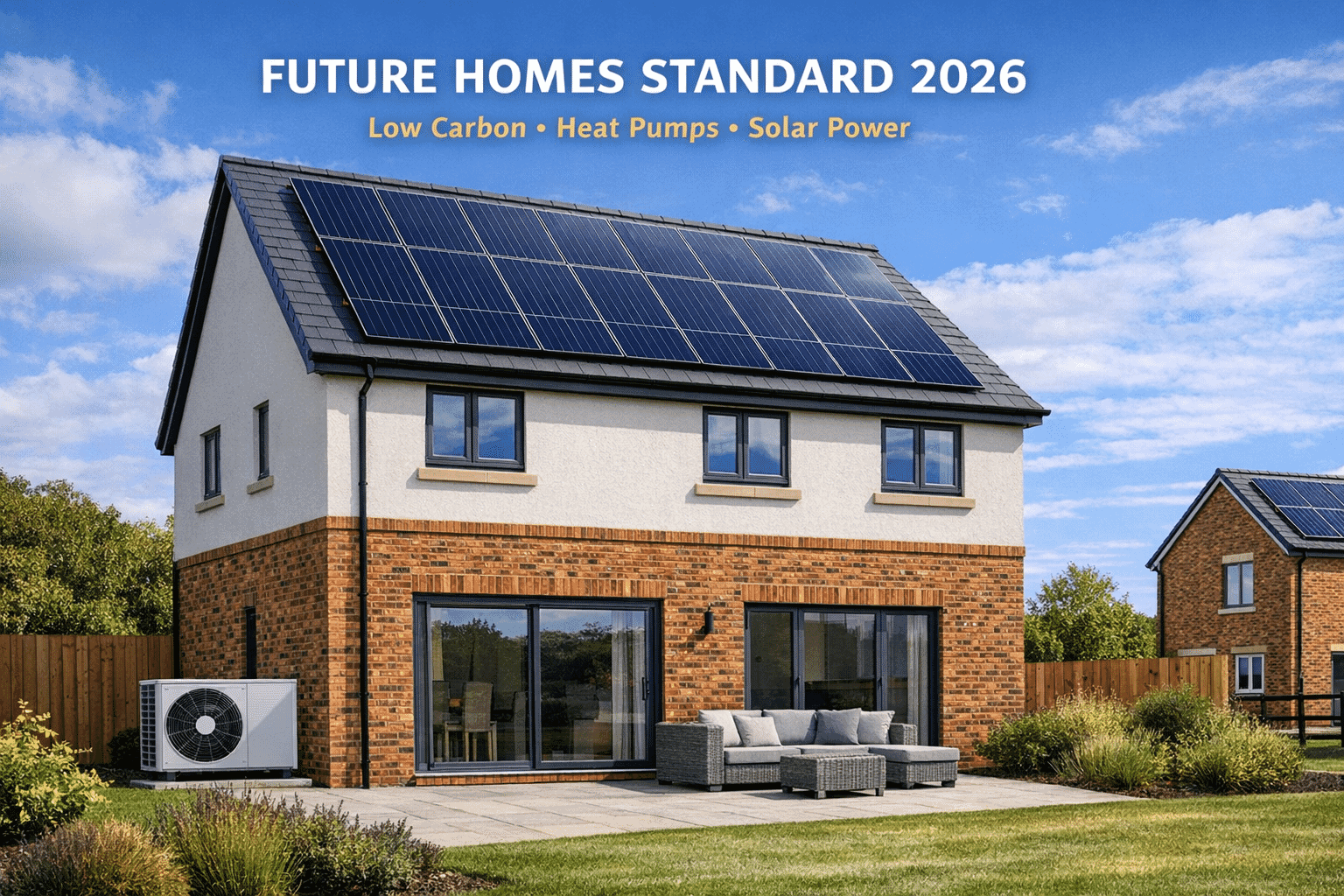
- Heat pumps are the default low-carbon solution for space and water heating.
- Decentralised mechanical extract ventilation (dMEV) becomes the notional ventilation strategy.
- Waste Water Heat Recovery Systems (WWHRS) are included in benchmarking but remain optional.
- SAP 10.3 is the mandatory compliance model. HEM (Home Energy Model) to follow later.
3. On-Site Renewables – Solar PV 🌞
- The standard expects rooftop solar PV to cover approximately 40% of the ground floor area.
- Tall buildings (~18 m+) are generally exempt, though many may still opt for PV.
4. Building Fabric & Airtightness 🧱
- Minimum U-values remain unchanged, but the notional SAP benchmark is now more stringent.
- Airtightness target tightened to ~4 m³/h·m² @ 50 Pa (down from ~5).
- TFEE benchmark is slightly more rigorous, supporting the new fabric targets.
5. Compliance & Performance Metrics
- Compliance measured via SAP 10.3.
- Performance assessed on:
– Dwelling Primary Energy Rate (DPER)
– Dwelling Emission Rate (DER)
– Dwelling Fabric Energy Efficiency (DFEE) - Carbon emissions reduction target: ~75–80% compared to 2013 baseline.
6. Why It Matters
Implementing the Future Homes Standard aims to achieve:
- 🔋 Long-term carbon savings and lower energy costs for homeowners
- 📈 Futureproofing of projects for grid decarbonisation
- ✅ Compliance readiness aligned to tightened regulations
📞 Next Steps & How We Can Help
We are ready to help developers and builders meet Future Homes Standard requirements. Get in touch with us: